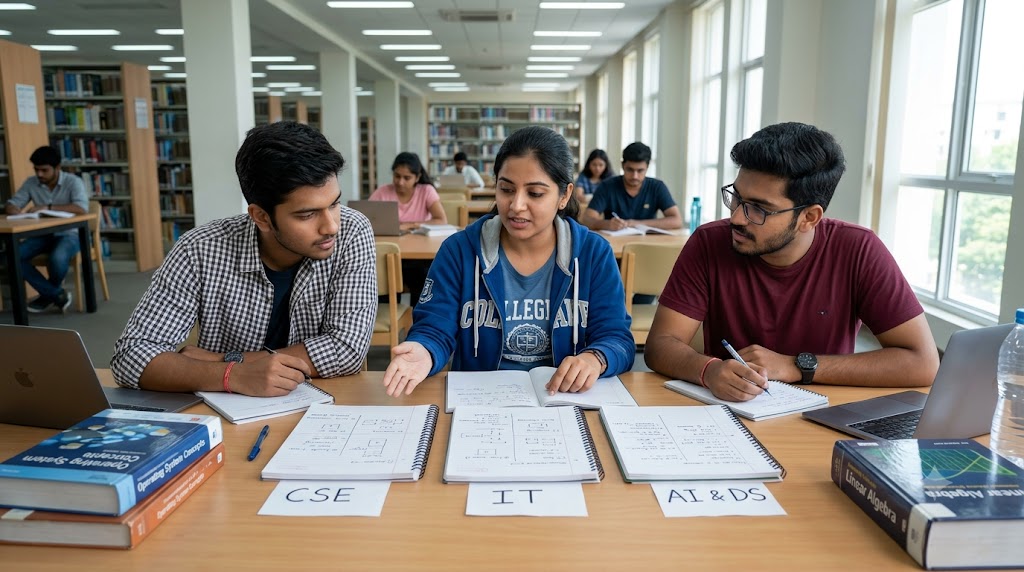
Comparing CSE, IT, and AI & Data Science for MHT-CET? Real syllabus breakdown, 2025 cutoff data for PICT, VIT Pune, VJTI, placement truth, and a percentile checklist. Free predictor inside.
CSE vs IT vs AI & Data Science: The Real Difference in MHT-CET Engineering Branches
Comparing CSE, IT, and AI & Data Science for MHT-CET? Here's the honest answer: these three branches are more similar than their names suggest — but the differences that do exist matter for your syllabus, your campus placement, and how fast these seats fill up at Maharashtra's top colleges.
This is not a generic India-level comparison. This article pulls 2025 CAP cutoff data for PICT, VIT Pune, and VJTI — the colleges that matter most to MHT-CET students in this percentile range — and includes a percentile checklist at the bottom to make this immediately useful for building your CAP college list.
For a deeper look at how to think through branch selection overall, see the Campusjourney Engineering Branch Selection Guide.
What Do CSE, IT, and AI & Data Science Actually Teach You?
CSE, IT, and AI & Data Science all train software engineers — but with meaningfully different emphases. CSE covers the broadest theoretical foundations: algorithms, operating systems, compilers, data structures, and system design. IT focuses on applied computing: web development, cloud systems, networking, and enterprise applications. AI & Data Science concentrates on mathematics-heavy machine learning, deep learning, data engineering, and statistical modelling.
At most Maharashtra engineering colleges, the syllabus overlap between CSE and IT is roughly 60–70%. AI & Data Science shares around 50% with CSE. The remaining curriculum is where the real differentiation begins.
Computer Science Engineering (CSE)
Think of CSE as the "full depth" version of computing. You go deep into theory — discrete mathematics, automata, compiler design, operating systems — alongside rigorous programming. Students who enjoy understanding how systems work at a fundamental level tend to thrive here. CSE opens the widest range of software careers: product companies, startups, government tech, core engineering, and beyond.
Information Technology (IT)
IT is CSE's more application-focused cousin. You cover networking, cloud systems, cybersecurity, and enterprise software in more depth — with less time on pure CS theory. Most students find IT slightly more applied and industry-relevant from Year 1. The gap from CSE is considerably smaller than most students assume.
AI & Data Science (AI&DS)
AI&DS is the most mathematics-intensive of the three. Probability and statistics, linear algebra, Python for machine learning, deep learning algorithms, and data engineering form the core. If you struggle with mathematics, this branch will be genuinely difficult. But if statistical thinking and data patterns interest you, AI&DS is the most directly aligned to where the job market is heading in 2026.
How Different Are the Syllabuses, Really?
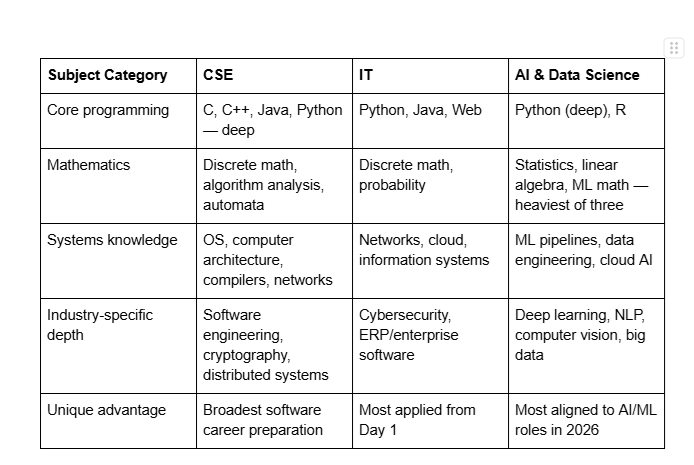
The figure most students don't know: CSE and IT share approximately 60–70% of their curriculum at the same Maharashtra college. AI & Data Science shares around 50% with CSE. A motivated student in any of these three branches can develop skills that make them competitive across all three career paths.
image
The most important thing this table shows: branch is your starting point, not your ceiling. An IT student who builds strong algorithms and system design skills is interview-competitive with CSE graduates for the same product company roles. An AI&DS student who adds coding fundamentals has access to the same service IT placements as CSE students.
What branch determines is the depth of your starting curriculum. What determines your actual career options is what you build on top of that — and which college you do it in.
Which Branch Fills Up First at Maharashtra's Top Colleges?
At elite Maharashtra colleges, all three branches fill up within a very narrow percentile band. The gap between CSE (highest cutoff) and AI & Data Science (lowest of the three) is smaller than most students expect — particularly at PICT and VJTI.
Here's what the 2025 CAP Round 1 data showed:
PICT Pune — 2025 CAP, GOPENH category:
- Computer Engineering: ~99.71 percentile
- AI & Data Science: ~99.61 percentile
- Information Technology: ~99.55 percentile
VIT Pune — 2025 CAP, OPENS category:
- Computer Engineering: ~98.95 percentile (closing rank ~3,505)
- Information Technology: ~98.58 percentile (closing rank ~4,811)
- CSE (AI & ML): ~98.44 percentile (closing rank ~5,328)
- AI & Data Science: ~98.11 percentile
VJTI Mumbai — 2025 CAP, GOPENH category:
- Computer Engineering: ~99.95 percentile
- Information Technology: ~99.90 percentile
Two things stand out from this data.
First, at PICT, AI&DS closes higher than IT. That's because PICT's AI&DS programme has fewer seats and very high demand — so the branch that "sounds lower" actually has a tighter cutoff than IT there. This is a detail generic branch comparison guides will never tell you — it's specific to PICT's seat matrix.
Second, at VIT Pune, the gap between CSE and AI&DS is about 0.84 percentile. That's real — for students in the 97–99 range where every decimal matters. But the more important question isn't "how big is the gap between branches at the same college?" It's: "which branch at which college tier does my percentile open up?"
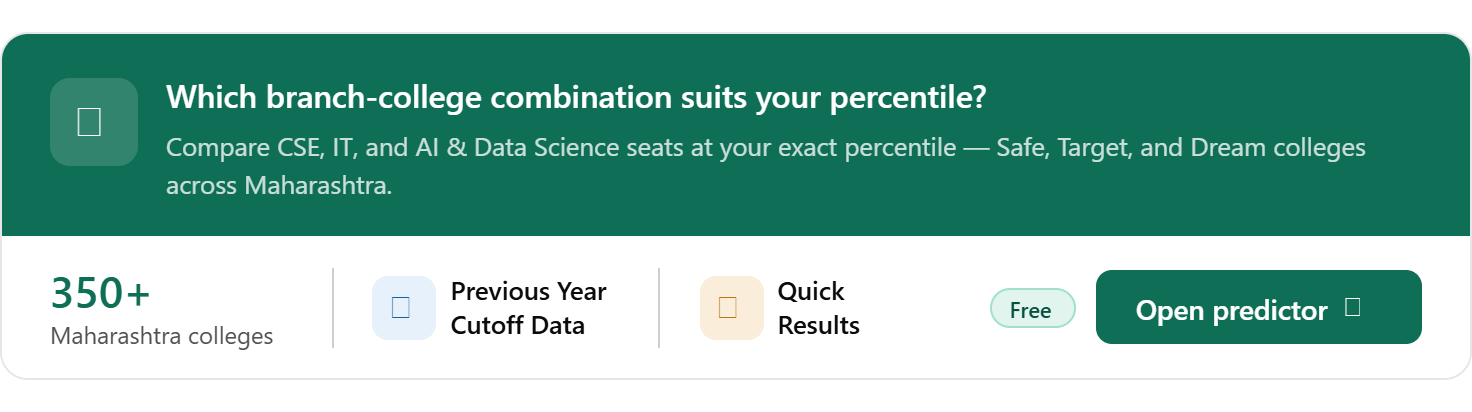
If you have 97.5 percentile, you're not deciding between CSE and AI&DS in the abstract. You're deciding between CSE at VIT Pune or AI&DS at PICT — and those are very different choices. Use the Campusjourney predictor to see what each branch option actually looks like at your percentile across 350+ Maharashtra colleges.
Do Companies Treat AI & DS Students Differently in Campus Placements?
For mass IT recruiters — TCS, Infosys, Wipro, Cognizant, Capgemini — there is no meaningful difference between CSE, IT, and AI&DS eligibility. All three branches qualify for mass drives, and selection comes down to aptitude tests, coding rounds, and communication skills.
The real differences show up in two specific situations.
AI/ML-specific product roles: Companies hiring for data scientist, ML engineer, NLP engineer, or AI product roles will look for AI&DS curriculum alignment first. At Tier-1 colleges and in off-campus job applications, having AI&DS on your degree sends a stronger signal for these specific positions. But at Maharashtra Tier-2 and Tier-3 campuses, most placement drives are service IT companies — so this advantage mainly plays out in off-campus job searches after graduation.
Internships during college: Students who target data science or ML internships in Years 2 and 3 consistently find AI&DS more directly aligned to what those roles require. The Python and ML foundation from the curriculum gives AI&DS students a head start — but CSE or IT students who self-study ML can close this gap.
The honest package picture: At a good autonomous college, the average package difference between CSE and IT graduates is typically marginal at the fresher level — often under ₹50,000 per year at the first job. AI&DS graduates targeting AI/ML-specific roles can command meaningfully higher starting packages, but those roles require hands-on skills the degree alone won't guarantee.
What this means for your decision: If your career direction is clearly AI, data science, or machine learning — AI&DS is the most aligned starting curriculum. If you're unsure, CSE or IT at a well-placed autonomous college gives you the widest net. The college matters more than the branch for most students.
CTA
The Real Question: Branch or College — Which Matters More?
College quality affects your career outcome more than branch name at the same quality tier. Placement networks, faculty quality, company relationships, NAAC accreditation, and peer calibre are institutional — they apply to every branch in that college. A motivated IT or AI&DS student at PICT will typically outperform a CSE student at a non-autonomous Tier-3 college. Choose the better college first.
This is the one thing we repeat in almost every Pune counselling session: students come in thinking the branch name on their degree is what gets them placed. What actually gets them placed is the college's placement record, the companies that visit campus, and the network they build over four years.
The mental model to use: think of your decision as a branch × college matrix, not just a branch choice. The question isn't "which branch is best?" — it's "which branch gets me the best college tier at my specific percentile?"
A 0.5-percentile difference between CSE and AI&DS at the same college may not seem like much. But that same 0.5 percentile could open or close access to an entirely different college tier. That's the real trade-off.
Your Percentile Checklist: Which Branch at Which College
Your branch choice for CAP depends on which combination gives you the best college tier at your percentile. Based on 2025 CAP data, here's a guide to what each percentile range can realistically target — GOPENH/OPENS category.
If your percentile is 99.5 and above: CSE, IT, and AI&DS at PICT Pune are all within range. At this level, focus on ordering preference within top colleges — all three branches at this tier deliver strong outcomes. VJTI Computer Engineering and IT require 99.9+.
If your percentile is 98 to 99.5: VIT Pune CSE becomes realistic. AI&DS at PICT is just within reach. This is the range where the PICT AI&DS vs VIT CSE calculation is most relevant — compare both options using actual placement data, not just branch name.
If your percentile is 95 to 98: Good autonomous Pune colleges (MIT-WPU, Sinhgad Institutes, PCCOE, DY Patil Akurdi) open up for CSE and IT. AI&DS at these colleges typically closes 0.3–0.8 percentile lower than CSE — a meaningful difference at this range. Consider whether AI&DS at a slightly better-ranked autonomous college beats CSE at a lower-ranked one.
If your percentile is 90 to 95: Autonomous colleges outside Pune — Nashik, Aurangabad, Nagpur — become more realistic for CSE. AI&DS at good Pune autonomous colleges is also possible at the lower end of this range. NAAC accreditation and placement records should drive the decision more than branch name at this percentile.
If your percentile is 85 to 90: Focus on NAAC A or NAAC A+ accredited colleges regardless of branch. Branch differences matter less at this tier — institutional quality is the dominant variable. IT and AI&DS typically close 0.3–1 percentile lower than CSE at the same college, which can be worth using to access a better-accredited institution.
This checklist is based on 2025 CAP data, sourced from published education portals. Cutoffs shift every year. Use this as orientation only — always verify using current official CAP data at dtemaharashtra.gov.in and cetcell.mahacet.org.
Want to build your full college list based on your exact percentile, category, and preferred branches? Use the Campusjourney predictor — it generates Safe, Target, and Dream colleges across all three branches with DTE codes included, ready to reference when you fill your official option form on the CET Cell portal.
Frequently Asked Questions
Is AI & Data Science a good branch in Maharashtra engineering colleges?
AI & Data Science is one of the strongest branch choices for 2026. Industry demand for AI and data professionals is growing fast, and AI&DS is the most curriculum-aligned starting point for data science, ML engineering, and analytics roles. At a good autonomous college, it offers comparable or better career outcomes than CSE for AI-focused careers — at a slightly lower MHT-CET cutoff than CSE at the same college.
What is the actual difference between CSE and IT in Maharashtra engineering?
At most Maharashtra colleges, CSE and IT share 60–70% of their syllabus. CSE goes deeper into theoretical computer science — algorithms, operating systems, compiler design — while IT focuses more on applied computing: networking, cloud systems, enterprise software, cybersecurity. Most employers treat CSE and IT as equivalent for general software roles. Cutoffs typically differ by 0.2–0.5 percentile at the same college, with CSE closing higher.
Do companies treat AI & Data Science students differently than CSE in campus placements?
For mass IT recruiters (TCS, Infosys, Wipro), all three branches qualify equally. AI&DS students are specifically prioritised for data science, ML engineer, and AI-specific roles. At Maharashtra Tier-2 colleges where most on-campus drives are service IT companies, the placement eligibility difference is minimal. The AI&DS advantage is most visible for students pursuing AI/ML-specific off-campus roles or product company positions.
Which branch has a lower cutoff — CSE, IT, or AI & Data Science in MHT-CET?
Across Maharashtra colleges, CSE typically closes highest. At PICT Pune in 2025 (GOPENH), Computer Engineering closed at ~99.71 percentile, AI & Data Science at ~99.61, and IT at ~99.55. At VIT Pune (OPENS), Computer Engineering closed ~98.95 and AI & Data Science ~98.11. The gap varies by college — at PICT, AI&DS actually closes higher than IT due to limited seats and high demand.
Should I choose AI & Data Science over CSE if I cannot get CSE at a well-ranked college?
Yes, in most cases. AI&DS at a well-ranked autonomous college consistently delivers better career outcomes than CSE at a non-autonomous or poorly-placed college. A better college's placement network, faculty quality, and company relationships outweigh the branch name difference. Run the comparison for your specific percentile using the Campusjourney predictor before deciding.
Can AI & Data Science students get software development jobs like CSE students?
Yes. AI&DS students are eligible for software development roles in most campus placement drives. Mass IT companies include AI&DS as a qualifying branch. The core coding and aptitude requirements are the same. The distinction is in specialised roles — AI&DS graduates have a curriculum advantage for data engineering, ML, and analytics-specific positions that CSE students need additional self-study to match.
Before You Finalise Your Branch Decision
The branch question does not have one answer for everyone — but it has a right answer for you, based on your percentile, your career direction, and what college each branch puts within reach.
Three things to do right now:
Enter your MHT-CET percentile in the Campusjourney predictor and compare what CSE, IT, and AI&DS each get you across 350+ Maharashtra colleges — with DTE codes ready to use when you fill your official option form on the CET Cell portal. The college tier difference across branches is often more important than the branch name itself.
Be honest about mathematics. AI&DS has the heaviest statistics and probability load of the three. If you find maths difficult, CSE or IT gives you more room to focus on programming skills. If you enjoy data patterns and statistical reasoning, AI&DS is the right starting point.
Check the Campusjourney Admission Guide 2026 for the complete CAP process — registration, document requirements, round-wise strategy, and seat allotment explained.
CTA
You have the data. Build your college list around the best college your percentile can reach — in whichever of these three branches gets you there.
Disclaimers:
Cutoff data cited is from 2025 CAP rounds, sourced from Tier 2 education portals (Careers360, CollegeDunia, FindUrCollege) which aggregate official DTE Maharashtra published data. Cutoffs vary year to year based on candidate pool, seat availability, and overall competition. Treat all figures as reference only, not as forecasts. Always verify current-year official cutoffs at dtemaharashtra.gov.in and cetcell.mahacet.org.
Campusjourney is an independent guidance platform and is not affiliated with the Government of Maharashtra, the State CET Cell, or DTE Maharashtra. For official information, visit cetcell.mahacet.org and dtemaharashtra.gov.in.
The information in this article is for general guidance. Individual situations vary based on category, percentile, home university region, and personal preferences. For personalised guidance, visit Campusjourney's Pune counselling centre or connect via WhatsApp support.
Tagged under:
Plan your next step
Explore Maharashtra engineering colleges and connect with our counselling experts for one-on-one admission guidance.